
How Overwatch 2’s PvE Became a ‘Nintendo Switch Nightmare’ Blizzard Refuses to Abandon
Overwatch 2 story missions faced immense optimization challenges on Nintendo Switch, demanding innovative solutions from Blizzard developers.
The saga of getting Overwatch 2’s glorious, long-awaited story missions to even boot on the Nintendo Switch wasn’t just a technical hurdle—oh no. For the wizards at Blizzard, it was a soul-crushing odyssey, a nerve-fraying descent into the very bowels of hardware hell. While gamers around the globe were salivating over the Invasion update, the developers were locked in a fluorescent-lit bunker, waging a silent war against a portable console that seemed hellbent on reminding them of every single one of its 2015-era limitations. The result? A Frankensteinian masterpiece of optimization that one might call ‘miraculous’, and the devs affectionately labeled ‘a big headache’—a term so understated it practically requires a sarcasm font.
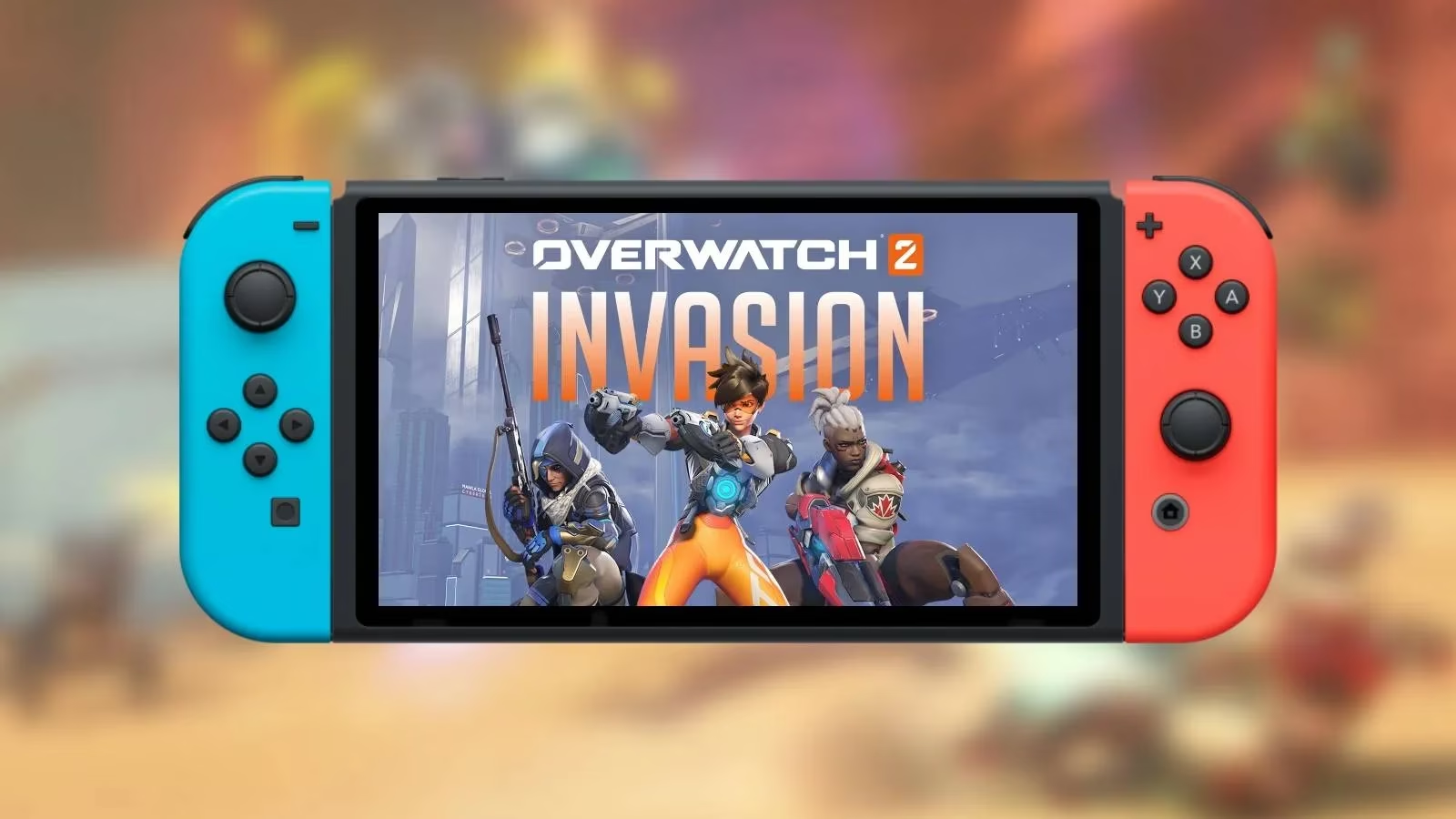
From the moment Season 6: Invasion was conceived, the Nintendo Switch was the proverbial anchor chained to the speedboat of innovation. Senior game designer Dylan Snyder, clutching a stress ball shaped like a Power Moon, has since confessed that the Switch is consistently the studio’s \“biggest bottleneck for performance.\” Imagine trying to squeeze a raging, particle-effect-laden dragon through a keyhole designed for a field mouse—that was the daily reality. Every new PvE map, every chaotic enemy wave, every time Tracer decided to blink and pulse bomb a fortified BOB, the Switch would groan like a banshee. The frame rate threatened to detach from reality entirely, turning fast-paced Overwatch action into a slideshow of regret.
But here’s the twisted beauty of this silicon-based torture: Blizzard has developed a sort of Stockholm syndrome for the little tablet that couldn’t. Snyder, with a pained grin, described the Switch as \“almost a nice bottleneck to have.\” This mind-bending statement reveals a core truth—if something can survive the Switch’s RAM-starved, underclocked gauntlet, it will sing like a silicon angel on the monstrous PS5 and Xbox Series X|S. The conquest birthed entirely new proprietary tools within the Blizzard engine, arcane systems dedicated to ruthlessly eviscerating unused memory mid-game, ensuring that not a single wasted kilobyte hangs around to crash the party. It was less game development and more digital exorcism.
The auditory battlefield was just as savage, a symphony of compromise orchestrated by audio and technical narrative director Scott Lawlor. Picture Lawlor, headphones clamped on, listening to a cinematic PvE cutscene where Reinhardt’s glorious charge suddenly sounds like it’s being filtered through a tin can underwater. The solution wasn’t to fix the audio; it was to dynamically gut it to save the frame rate. Every explosion, every cheeky voice line, every frantic \“I need healing!\” was on a precarious kill list. If the Switch started to sweat, the audio engine would ruthlessly dial down, prioritizing keeping bullets flying over keeping eardrums immersed. Lawlor believes the final mix turned out \“very well\”—and indeed, managing to preserve the game’s sonic soul while the CPU begged for mercy was a feat of acoustic triage worthy of a standing ovation.
The hellish journey was further complicated by the ghost of the canceled Hero mode, which left the narrative team scrambling to deliver pure, undiluted PvE goodness via these story missions. The weight of expectation hung over them like a radioactive mushroom cloud. And let’s not forget the real-world intrusions—like WWE superstar John Cena accidentally gatecrashing some poor streamer’s immersive PvE run, a moment that symbolically represented the sheer unpredictability of the entire launch window. But through the chaos, the Switch port became a perverse badge of honor. It’s a monument to the idea that no player should be left behind, even if their chosen console is technically more potato than powerhouse.
Fast forward to the triumphant Season 6: Invasion launch, priced at a tempting $15 for the bundle. The digital streets ran red with enemies, and the story finally unfolded—and miracle of miracles, it was playable on the toilet, on the bus, in the park, all on Nintendo’s plucky hybrid. The scale of the achievement cannot be overstated. By 2026, as Overwatch 2 continues to evolve, that foundational pain still reverberates. Every new map, every new hero like Illari, carries a whisper of that original Switch compromise baked into its code. So next time you effortlessly dive into a story mission on your PS5, spare a thought for the Blizzard engineers who stared into the 720p abyss of the Switch’s docked mode and, through sheer force of will, taught it to dream bigger. It wasn’t just a port; it was a spectacle of suffering that gifted us the magic of Overwatch 2 anywhere. 🎮💀
Leave a Comment