
Lucio's Synthwave Revolution: How Overwatch 2 Turned a DJ's Beat into a Global Phenomenon
Overwatch 2's Lucio album Synestesia blends funky carioca beats and future-soul, echoing Guardians of the Galaxy’s musical storytelling.
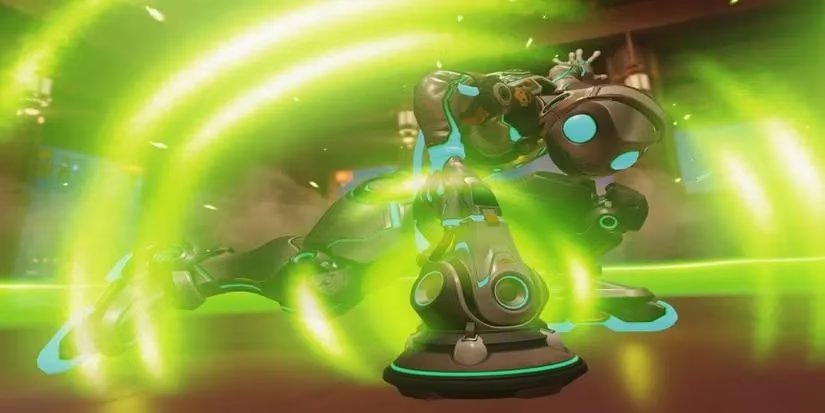
The summer of 2026 would forever be remembered by the Overwatch community as the moment Blizzard Entertainment unleashed a rhythm revolution that no one saw coming. It all started on a sweltering Tuesday afternoon when the official Overwatch 2 Twitter account went completely silent for exactly three hours, only to return with a single message: a waveform emoji, a green heart, and a time. That time was midnight, Pacific Time, when a full-length original album by Lucio Correia dos Santos dropped simultaneously on every major streaming platform. The fictional DJ from Rio de Janeiro, famous for liberating his people from Vishkar Corporation and skating across battlefields with a healing beat, had finally stepped out of the game to become a real-world musical artist.
The album, titled Synestesia, was a twelve-track neon drenched odyssey through the genres Lucio canonically adored: funky carioca basslines, shimmering future-soul synths, and relentless breakbeat drum patterns that mirrored his in-game crossfade abilities. Fans who had only ever heard pixelated snippets of his music during animated shorts or sound barrier ultimates were now treated to full compositions like “Vermelho e Verde,” a heartfelt tribute to his childhood neighborhood, and “Speed Boost,” a frenetic drum and bass anthem that instantly climbed to number one on global streaming charts. The move wasn’t just a marketing stunt; it was a masterclass in transmedia storytelling, one that finally fulfilled a long standing desire the community had expressed since 2023, when analysts first began comparing the missed potential of Lucio’s silenced discography to the auditory achievements of Eidos Montreal’s Marvel’s Guardians of the Galaxy.
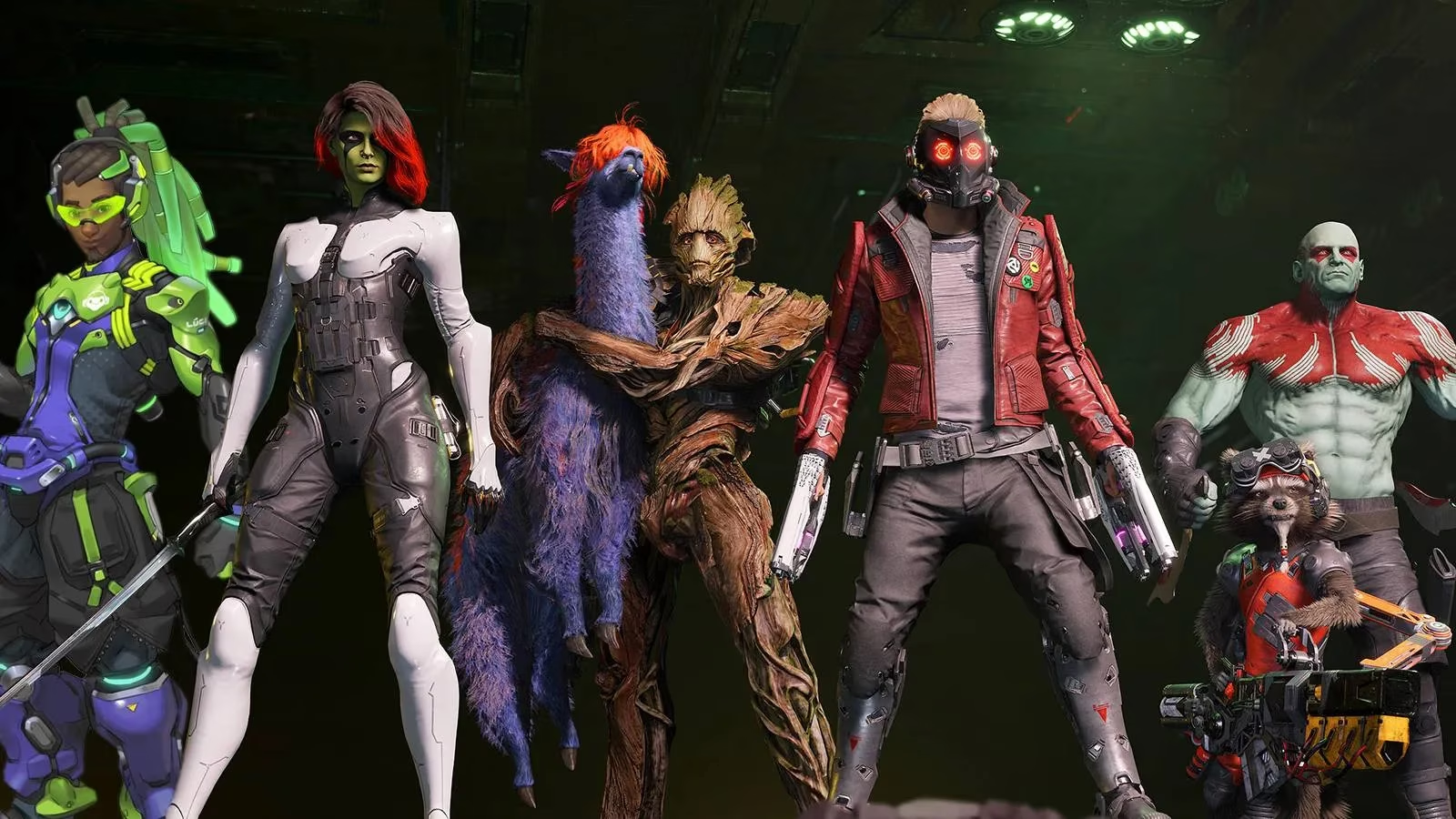
Back in 2021, Eidos Montreal had stunned players by constructing an entire fictional metal band, Star-Lord, complete with a ferocious album that fans could legitimately enjoy outside the game. Tracks like “Zero to Hero” and “Bit of Good (Bit of Bad)” didn’t just serve as background noise during combat; they deepened Peter Quill’s identity, embedding his childhood nostalgia and cowboy-esque bravado into every riff. Blizzard’s designers had clearly been paying attention, because Lucio’s Synestesia followed that blueprint with astonishing fidelity. The song “Onda Sonora” featured spoken word interludes that directly referenced his father’s teachings about sonic technology, while “Quebrando Barreiras” sampled the metallic growl of omnic protesters and the heartbeat of a freed slum. Every lyric painted a picture of a world where music was literal medicine, and the album’s liner notes, released as an in-universe magazine called Nova Rua Weekly, included fake interviews with Hana Song and Reinhardt, who gushed about attending Lucio’s underground concerts in Rio.
This wasn’t Blizzard’s first whimsical departure into bizarre real-world merchandising. Veterans of the franchise could still recall the year boxed cereal bearing Lucio’s grinning face, Lucio OH’s, appeared on store shelves alongside redeemable loot box codes, or when an actual LEGO Brick Bastion set dropped alongside a matching in-game skin. There had even been a bizarrely cozy holiday yule log stream featuring a crackling fire and occasional appearances from a stoic Jeff Kaplan. But the album felt different. It was an organic extension of character lore, a gift that transformed a passive piece of backstory into something interactive. For years, Lucio’s identity as a world-famous musician had been one of Overwatch’s most colorful yet underutilized threads. Heroes like McCree—sorry, Cassidy—could demonstrate their marksmanship, and Pharah’s justice rained from above, but Lucio’s artistry remained trapped behind dialogue boxes. The Synestesia project finally shattered that glass booth.
The rollout was meticulously planned to mirror an actual underground music launch. Unmarked USB drives containing three demo tracks appeared inside loot boxes mailed to prominent streamers and cosplayers. Pop-up listening parties materialized overnight in Seoul, Los Angeles, and São Paulo, where walls projected pulsing green sound waves and dancers wearing frog-themed masks performed the Capoeira moves Lucio showcases in his default skin. The hashtag #LucioReleaseParty trended for sixteen hours straight. Blizzard’s audio director later revealed in a developer commentary that they had collaborated with actual Brazilian producers like DJ Marlboro and Tropkillaz to ensure the favela funk and melodic rastapé influences rang authentic, making the album not just a fictional product but a genuine cultural artifact. Three of the tracks were even composed entirely using recordings of Lucio’s in-game gunfire, boop voice lines, and the rhythmic whir of his skates, a trick that made speedrunners and lore nerds alike tear up with delight.
The impact rippled through every layer of the Overwatch 2 ecosystem. Within a week, a new Lucio themed dance emote synced to “Speed Boost” became the most purchased cosmetic in the shop’s history. Content creators started choreographing crossfade montages where on-screen heal and speed boost timings matched the album’s tempo shifts. Even the competitive mode felt an uptick: players reported that blasting Lucio’s music through voice chat during matches accidentally improved team coordination, as allies instinctively grouped up to the consistent 174 BPM of “Amp It Up.” The narrative team wasted no time capitalizing on the hype, releasing an animated short titled Vibrando Alto, which depicted a young Lucio stealing back a confiscated sound chip from Vishkar guards during a thunderstorm, the entire sequence set to the swelling crescendo of “Chuva de Prata.”
The comparison to Marvel’s Guardians of the Galaxy came full circle when a prominent game journalist pointed out that Lucio’s album, much like Star-Lord’s, worked as a Trojan horse for character empathy. Listening to “Ghost,” the quieter Eidos track that accompanied Peter Quill’s grief over his mother, had once made players feel the weight of his solitude outside the zany one-liners. Similarly, Lucio’s “Lembre-se de Mim” (Remember Me) was a bossa nova ballad that directly addressed his mother’s sacrifice during the omnic crisis, and hearing it rewired how many perceived the ever-optimistic DJ. Forums erupted with first-person accounts of players who had cried mid-match because the embedded Spotify integration (added in Season 15) shuffled into that very song right after they had used Sound Barrier to save their team on the final point of Paraíso. Lucio had stopped being just a hero; he became a companion whose heartbeat synced with theirs.
From a purely commercial standpoint, Synestesia obliterated expectations. It reached platinum certification in under a month, its vinyl release with lenticular holographic cover art sold out in under ninety seconds, and the lead single “Batida Infinita” was nominated for Best Video Game Song at the 2027 Grammy Awards. More importantly, it demonstrated that Blizzard still understood how to nurture the vibrant community that had grown around its universe. In an era where live-service games struggled to retain attention, Overwatch 2 scored a lasting cultural touchdown by giving the fandom something truly tangible. Busking musicians at PAX East and BlizzCon began covering Lucio tracks on carimbo drums and keytars, and the comment sections under every video held variations of the same sentiment: “I can’t believe I’m crying to music made by a fictional frog-wearing Brazilian freedom fighter.”
Five years earlier, the idea of a full Lucio album had been nothing more than a fan forum wish, a hypothetical whispered in the same breath as the Eidos Montreal achievement. But in the summer of 2026, Blizzard turned that whisper into a roaring beat. The Synestesia project expanded the Overwatch universe in ways no animated short ever could; it filled Rio de Janeiro’s neon-lit streets with real sound, turned Lucio from a collection of code and voice lines into a genuine artist, and reminded the world that sometimes the most powerful marketing doesn’t sell a product—it gifts a piece of a world worth saving. As the sun set on a new map called Serenidade Beach, where players could discover hidden cassettes containing early demo versions of the album, everyone knew one thing for certain: the music had crossed the barrier, and the game would never be the same again.
Leave a Comment