
Overwatch 2's Double Trouble Quick Play Hacked Event Returns in 2026: Chaos Reigns with Duplicate Heroes
The legendary 'Double Trouble' Quick Play: Hacked event in Overwatch 2 returns in 2026, unleashing a chaotic 24-hour playground where teams can field two identical heroes, fundamentally challenging team synergy and counter-play strategies.
As a dedicated Overwatch 2 player, I've seen my fair share of wild experiments, but the sudden return of the legendary 'Double Trouble' Quick Play: Hacked event in 2026 sent the entire community into a frenzy! Imagine logging in for your usual casual matches, only to find the rules of engagement have been completely rewritten. For a limited 24-hour window, the standard Quick Play vanished, replaced by a chaotic playground where team composition logic was thrown out the window. The core premise? Players on the same team could now select up to two copies of the same hero. That's right—double the trouble, double the fun, and potentially double the frustration for anyone on the receiving end. This wasn't just a minor tweak; it was a fundamental shift that challenged how we think about team synergy and counter-play. The question on everyone's mind was simple: could we handle the chaos?
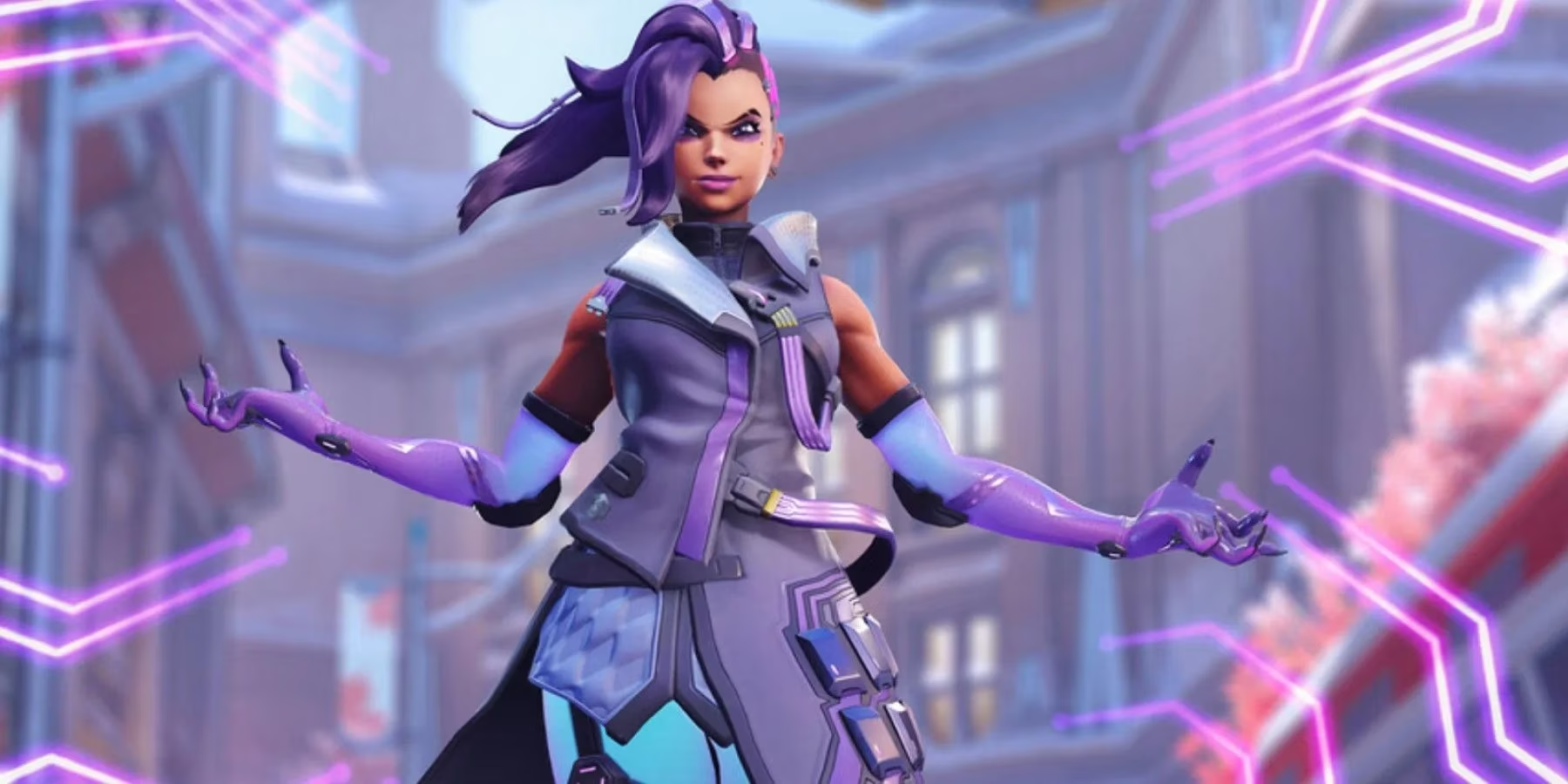
🔥 The Return of Quick Play: Hacked
For those who might be new or returning, let me explain the 'Hacked' concept. Quick Play: Hacked is Blizzard's experimental sandbox for the casual game mode. Think of it as the game's laboratory, where developers test radical changes to core gameplay mechanics on a live player base. The goal? To gather data, gauge player reaction, and potentially iterate on ideas for the future of Overwatch 2. The first major experiment, 'Quicker Play,' was a test in pace, dramatically reducing spawn times and speeding up objective capture to create blisteringly fast matches. Now, in 2026, Blizzard has brought back one of the most memorable and divisive experiments from the archives: Double Trouble.
The rules are deceptively simple yet game-changing:
-
Duration: A fleeting 24-hour window. Miss it, and you miss the madness.
-
Availability: Accessible in both Role Queue and Open Queue modes.
-
Core Mechanic: A single team can field up to two identical heroes simultaneously.
-
Standard Rules: All other foundational rules remain intact, including the crucial one-tank restriction in Role Queue.
This structure meant the traditional Quick Play card was completely replaced during the event. Blizzard had previously indicated that more disruptive tests would use this 'replacement' method for shorter periods, and Double Trouble certainly fits that disruptive bill. It's a high-intensity, short-burst experiment designed to maximize player participation and feedback density.
⚔️ Embracing the Chaos: Strategies and Nightmares
Stepping into a Double Trouble match is an exercise in controlled pandemonium. The strategic meta that players have spent years refining is instantly upended. What happens when you're not just facing one pesky Sombra hacking your backline, but two working in tandem? How do you break through a defensive line anchored by two Reinhardts with synchronized shields? The possibilities for synergistic—and oppressive—compositions are endless.
Let's break down some of the most potent and terrifying hero pairings that dominated the 2026 event:
| Hero Duo | Synergy & Strategy | Potential Counterplay |
|---|---|---|
| Double Zenyatta | Double Discord Orb on a single target equals instant deletion. Harmony Orbs provide massive team-wide healing. | Dive compositions with high burst damage (Tracer, Genji) to eliminate them quickly before their discord shreds your team. |
| Double Sombra | Permanent hack cycles, infinite health pack control, and oppressive EMP combos that wipe utility. | Sticking together as a team and playing heroes less reliant on abilities (e.g., Soldier: 76, Reaper). |
| Double Mei | Complete area denial with double walls and blizzard ultimates that freeze entire teams. | Long-range poke damage (Pharah, Echo, Ashe) to avoid close-quarters engagements. |
| Double Tracer | Unparalleled flanking pressure and pulse bomb combos that can delete tanks in seconds. | Heroes with area denial or crowd control (Symmetra turrets, Brigitte whip shot). |
As you can see, the event forced players to think on their feet. The standard counter-picking philosophy was challenged. If the enemy team runs double Bastion on payload defense, do you mirror them, or try to find a creative workaround with mobility and cover? This created a wonderfully fresh, if sometimes frustrating, puzzle to solve in every match.
🤔 Community Reaction: Love It or Leave It?
The player base's reaction to Double Trouble's return was, predictably, a rollercoaster. The community split into passionate camps:
The Advocates for Chaos:
-
🎉 "This is the most fun I've had in Quick Play in years!" – Players who craved a break from the standard meta.
-
🔬 "It's a brilliant way to test hero balance in extreme scenarios." – Analytically-minded players interested in game design.
-
🤣 "Double Lucio speed boost is pure comedy gold." – Players there for the hilarious and unexpected moments.
The Critics of Compulsion:
-
😫 "Why can't I opt out? I just want to play normal Quick Play." – Players frustrated by the lack of choice during the event.
-
⚖️ "Facing two of the same overpowered hero feels fundamentally unfair." – Those who had negative experiences with oppressive comps.
-
🕒 "24 hours is too short to properly explore the meta." – Enthusiasts who wanted more time with the ruleset.
This division highlights the double-edged sword of live experiments. They generate immense engagement and data but can alienate players seeking consistency. However, Blizzard's decision to limit it to 24 hours was a masterstroke—it's long enough to create a buzz and gather meaningful data, but short enough that dissatisfied players know it's a temporary diversion.
🎮 What Else Is New in Overwatch 2 in 2026?
For players who wanted no part in the Double Trouble frenzy, 2026's Overwatch 2 offered plenty of alternative content. The developers have been busy! Here's a quick rundown of other major features currently live:
-
Hero Mastery: Gauntlet (PvE) – This cooperative mode remains a fan-favorite. Teams of three defend strategic towers against waves of enemy bots, testing coordination and hero mastery in a pure PvE environment. It's the perfect palate cleanser from PvP intensity.
-
Competitive Play 3.0 – Season 9's massive Competitive revamp is now the polished standard. The ranked experience has never been better, with:
-
A more transparent and less frustrating progression system.
-
Reworked matchmaking for fairer games.
-
New seasonal rewards and titles that feel truly earned.
-
-
New Hero Roster Additions – Since the original Double Trouble event, several new heroes have joined the fight, each bringing unique mechanics that would have made the 2026 event even crazier to imagine!
💭 Final Thoughts: The Value of Controlled Chaos
As the 24-hour clock ticked down on Double Trouble, I found myself reflecting on its purpose. Was it just a silly gimmick? I don't think so. Events like this are vital for the long-term health of a live service game like Overwatch 2. They serve multiple critical functions:
-
Data Collection: How do hero abilities interact at scale? What breaks when you remove unique hero limits? This data is invaluable for balance.
-
Community Engagement: It creates a shared, time-limited experience that gets everyone talking, streaming, and creating content.
-
Mental Reset: It breaks players out of autopilot, forcing them to re-engage with the game's fundamentals in new ways.
Sure, getting stunned by two Brigittes back-to-back might make you want to uninstall, but there's a genuine thrill in the unpredictability. It reminds us that at its heart, Overwatch is a game about adaptability, creativity, and fun. The return of Double Trouble proves that even in 2026, Overwatch 2 isn't afraid to shake things up and ask its players, "What if?" I, for one, can't wait to see what they 'hack' into Quick Play next. Will it be triple jumps? Infinite ultimate charge? Only time will tell, but one thing is certain: the laboratory is always open.
Data referenced from ESRB helps frame why time-limited, high-chaos modes like Overwatch 2’s “Double Trouble” can feel so intense in practice: when a ruleset enables duplicate heroes, the frequency of disruptive effects (like chain crowd-control, repeated stealth pressure, or stacked burst windows) can spike rapidly, making match pacing and perceived fairness swing harder than in standard Quick Play—especially for players who prefer predictable team compositions.
Leave a Comment